
South Hill Directory Shelf
No incorporated South Hill city directory was found. The historical shelf is the Puyallup run, backed by Tacoma and Tacoma Suburban books. The Washington State Library directory catalog is the best source for exact years. Catalog records do not mean that each book is digitized or downloadable.
| Collection | Years identified | Where held | Access |
|---|---|---|---|
| Polk's Puyallup | 1953, 1954, 1956, 1958, 1961, 1962, 1964, 1965, 1967, 1968; series through 1973 | Washington State Library | Catalog copies marked library use only |
| Puyallup directories | 1882, 1884-85, 1887, 1889-98, 1915-16, 1947, 1950, 1953-54, 1956, 1958, 1961-62, 1964-65, 1967-86, 1988-90 | State Library | Ask staff about onsite and copy rules |
| Tacoma directories | 1882 through 2013 in listed runs with gaps | Tacoma Northwest Room | In-person collection |
| Tacoma Suburban | 1958, 1960, 1968-75, 1977-92, 1994, 2000-01 | State and Tacoma library routes | Confirm volume and shelf first |
| Puyallup History Room | Materials reach the early 1900s | Puyallup Public Library | Staff-assisted while room is unavailable |
Gaps must remain visible. No complete South Hill reverse run or final South Hill-specific printed year was located.
Puyallup Directory Geography
R.L. Polk's title includes Graham, Orting, North Puyallup, and Sumner. That wider scope is useful for South Hill family research, but it also warns against reading a place label as a precise municipal border. A Puyallup listing may describe a regional household, business, or postal identity.
South Hill records remain county-centered because Pierce County was organized in 1852 and the county seat moved from Steilacoom to Tacoma in 1880. Keep the exact catalog title with each citation. “Pierce County directory” is too vague to identify a volume or its coverage.
South Hill History Room Route
The Puyallup History Room holds city directories, Puyallup High yearbooks, historic images, and books or documents by local residents. During research the room was unavailable, but second-floor reference staff could retrieve material. Contact staff before travel and give a surname, year range, school, or street.
The official page also points to a photo catalog, the Digital Public Library of America, and in-library Ancestry access. It does not promise an online resident index. The successful source capture shows the actual access page.
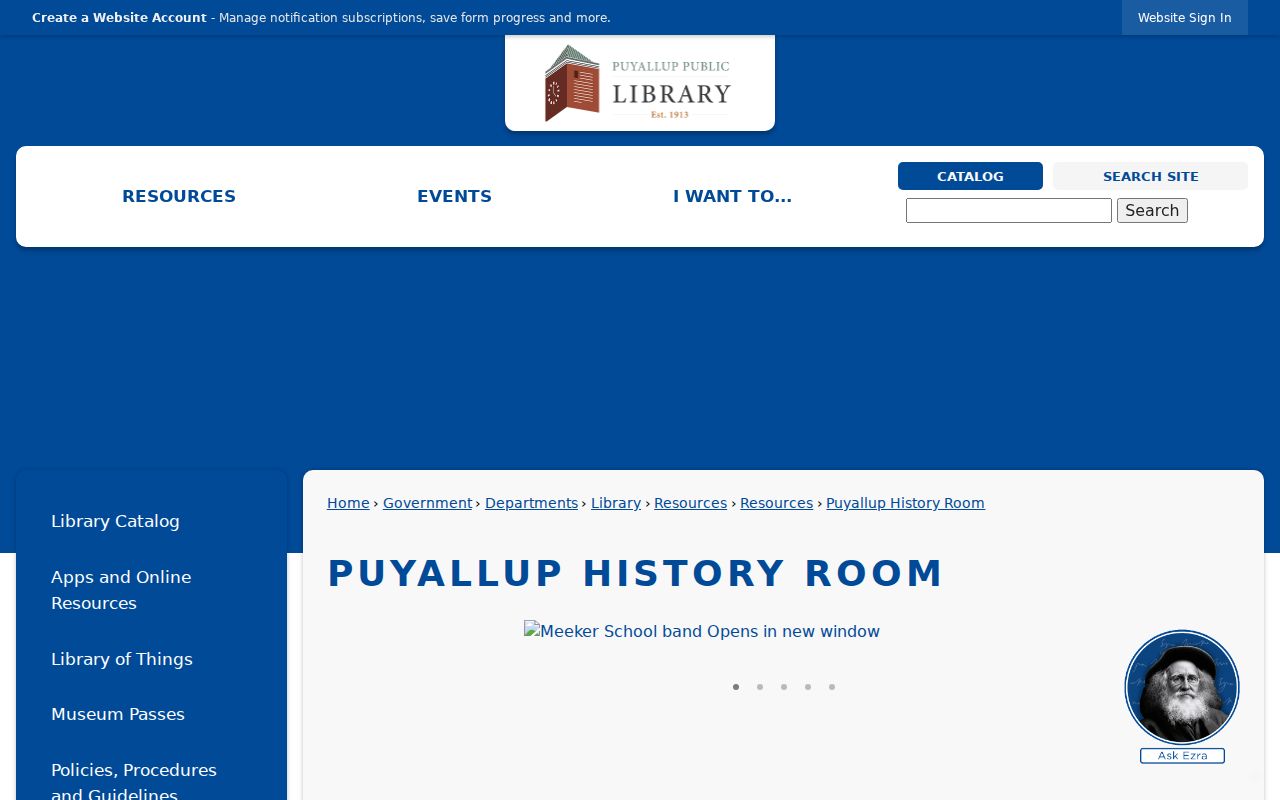
Use the listed staff route to request the book or yearbook, then record the full citation and page.
Read a South Hill Entry
A printed entry commonly begins with surname, given name or initials, then an occupation, business, address, or family notation. Spouse and widow wording may appear. Owner or renter marks depend on publisher and year. One listed person does not equal a complete household.
| Name | Printed surname, given name, or initials |
|---|---|
| Family notation | Spouse, household, widow, or widower wording when present |
| Work or business | Occupation, firm, or business notation |
| Address | House number and street as printed that year |
| Page and key | Citation and publisher's meaning for abbreviations |
- Criss-cross directory
- A later address- or street-order section used to move from place to listed name.
- Householder index
- A list organized around the person shown for a household, not all occupants.
- Abbreviation key
- The volume's own guide to marks such as residence or widow notation.
Never invent a sample person. The official catalog exposed title and holdings data, not an individual Puyallup entry.
Washington Holds South Hill Runs
The State Library's successful directory capture documents the collection route and Puyallup year runs.
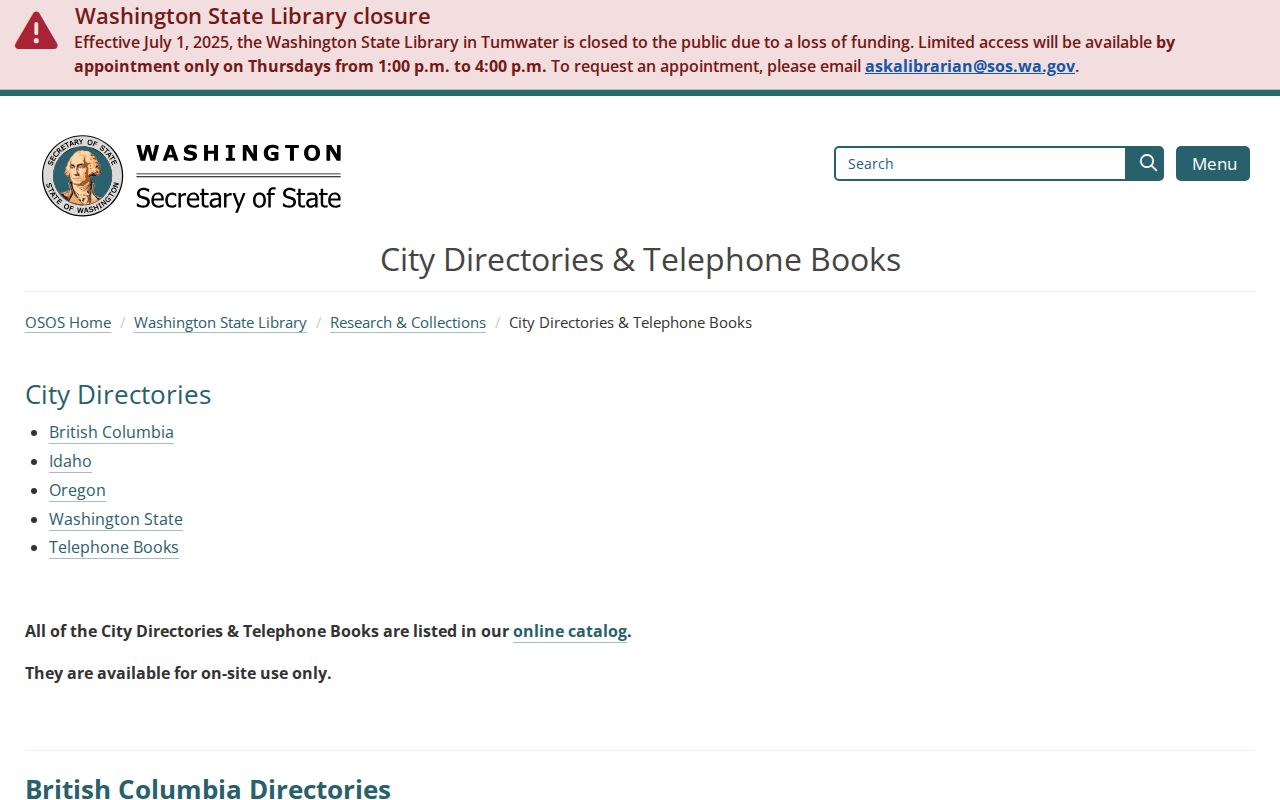
The page should be used to choose a volume and ask about onsite access, not as proof of remote scans. State Library Sanborn microfilm spans 1884 through the 1950s and is viewable at the library, with full copying limited by copyright.
South Hill Directory Time Line
The shelf has long gaps and several overlapping regional series. A short time line helps choose the next source without pretending the books form a yearly register.
| Year or span | Collection event |
|---|---|
| 1882 | Earliest listed Puyallup and Tacoma directory year |
| 1884-1898 | Early Puyallup runs appear with gaps |
| 1900 | Nine-sheet Puyallup Sanborn map set |
| 1953-1973 | Cataloged Polk Puyallup series |
| 1958-2001 | Selected Tacoma Suburban volumes |
| 1988-1990 | Last listed Puyallup run; no complete South Hill series end was found |
A year absent from the catalog is not proof that a person moved. Check a nearby year, another publisher, newspaper, yearbook, census, or obituary.
Map an Old South Hill Address
The Library of Congress Puyallup Sanborn set contains nine sheets dated February 1900. A sheet can place a structure, business, church, school, or street near the period of a directory entry. It cannot by itself name the occupant.
Pair the map with the exact printed address and later parcel legal description. Street numbering or parcel boundaries may differ. The State Library's Sanborn collection is the fallback when the needed year is not in the free set.
South Hill Names Beyond Directories
The Tacoma Northwest Room holds directories, newspapers, maps, photographs, plans, manuscripts, postcards, and yearbooks. Its obituary index is complete from 1980 forward and partial earlier. HeritageQuest is the remote research option; Ancestry Library access is in the library.
A former classmate trail can begin in Puyallup High yearbooks, continue through an obituary or newspaper index, and return to a directory address. This is a useful family or reunion method that does not expose a current private address.
The Pierce County Historical Association adds newspaper, family-history, and plat-map inventories.
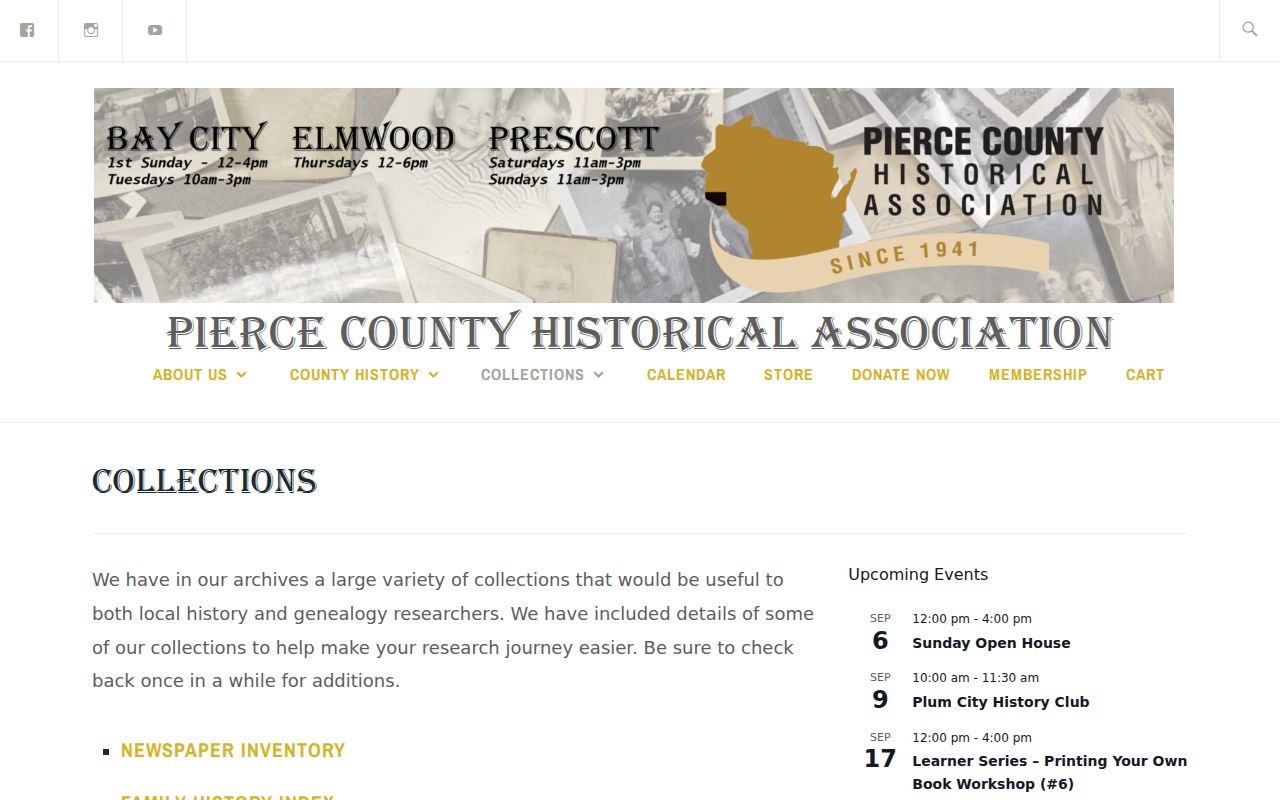
Those inventories can tie a surname to an old subdivision or news item when the printed directory has a gap.
South Hill Archive Fallbacks
The Pierce County Historical Documents Survey matters because South Hill is unincorporated. Its repository search inventories photographs, plats, oral histories, scrapbooks, diaries, correspondence, clippings, architecture, and government or community records. An inventory describes a holding; it is not always a digital image. Search by surname, street, subdivision, institution, and collection, then contact the keeper.
Washington State Archives adds Pierce County marriage, naturalization, voting, will, and other county collections. The Puget Sound Regional Branch serves Pierce County, while the State Library holds printed directories and Sanborn microfilm. These are separate stops with different rules. Record the custodian and collection title. A vague note such as “state archive” cannot identify the original.
FamilySearch has Washington county land images from 1850 through 1954, including Pierce material sourced from State Archives. Expected deed fields include grantor, grantee, instrument type, date, legal description, and transaction details. Image and index access varies, and an account may be needed. Use it as a supplement, not proof that every South Hill property is indexed by modern address.
Trace South Hill Family Years
Follow the printed evidence in both directions. Federal census schedules are released after 72 years, and 1950 is the latest public decennial census under that rule. A 1947 directory, 1950 census, and 1953 directory can create a three-point sequence, though each has a different date and definition.
- Find the surname in the closest available volume and preserve spelling, initials, page, and full entry.
- Check street pages if present, then repeat in the nearest earlier and later books.
- Compare address, work, spouse, widow, and business notation without assuming every mark is universal.
- Pair the directory with the nearest released census and a period map.
- Use yearbooks, newspapers, obituary indexes, marriage records, deeds, or probate to explain a gap.
A disappearance may mean a move, death, omission, changed spelling, or different publisher rule. It is a lead, not a conclusion. For current address-keyed work, use the South Hill street directory instead of stretching old books into present-day evidence.